
What is an AI Operating Partner (and how it differs from a consultancy)
An AI Operating Partner is an external partner that works with a company's leadership team to take artificial intelligence from pilots to business results. Unlike a consultancy, which usually delivers recommendations or a closed project, it works inside the company with its teams until results are measured and leaves the know-how in-house.

By Rafael Tamames, founder of Vivid Vision
What exactly does an AI Operating Partner do?
It brings together, in one team, four jobs that a company usually handles separately. The goal is for AI to stop being a collection of pilots and start moving business metrics.
- Align leadership
- Strategy sessions with the leadership team to move from conversation to action.
- Train the teams
- Training for management layers in AI applied to the business, and activation of the organisation's AI Champions.
- Govern AI
- Inventory of AI systems, risk classification, owners, controls and traceability, aligned with the AI Act.
- Implement with the team
- Prioritises use cases and implements them with the company's team until results are measured.
More detail: What is an AI Operating Partner, in the glossary
How does an AI Operating Partner differ from an AI consultancy?
The difference lies in where it works and how it is measured. A consultancy usually delivers recommendations or a closed project. An AI Operating Partner works inside the company with leadership: it trains the teams, prioritises use cases, defines AI governance and implements it with the team until results are measured.
| Traditional consultancy | AI Operating Partner | |
|---|---|---|
| What it delivers | Recommendations, a report or a closed project | An operating model running inside the company |
| Where it works | From outside, through deliverables | Inside the organisation, with leadership and the teams |
| How it is measured | By its deliverables | By business metrics: NPS, P&L and the AI adoption curve |
| Technology vendors | Depends on each firm | Vendor-agnostic: chooses and operates the platform that best serves the company's metrics |
| When it ends | Implementation is left to the company | The operating model and the know-how stay with the company |
A consultancy fits when you need a focused analysis or an expert opinion. An AI Operating Partner fits when the company has already tried AI and what it lacks is not vision but systematic execution.
How does an AI Operating Partner work?
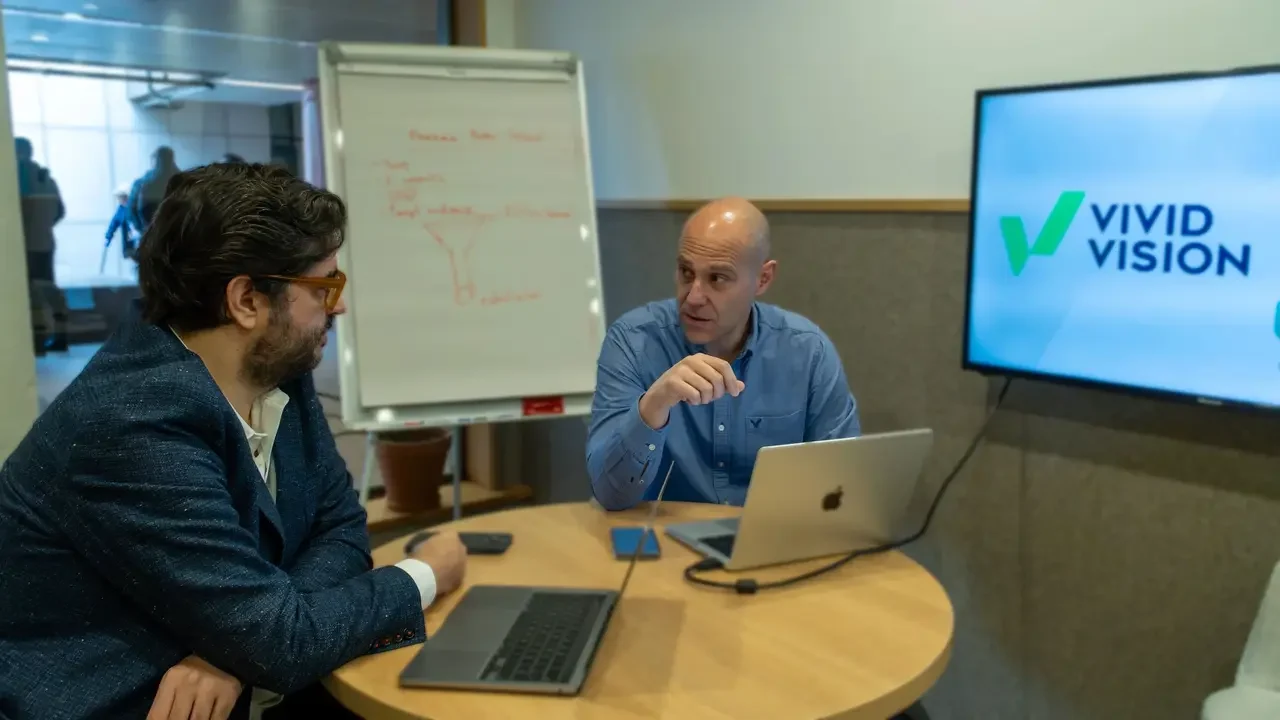
At Vivid Vision the work follows three phases: inspire leadership, activate the teams and operate inside the organisation.
- Inspire
- Keynotes and strategy sessions that move the leadership team to action.
- Activate
- Training for management layers in AI applied to the business, and activation of AI Champions. This is the Activate phase.
- Operate
- AI governance and new businesses, carried out inside the organisation. This is the Operate phase.
Which companies is an AI Operating Partner right for?
Medium-sized and large companies in Spain and Latin America whose leadership teams have already tried AI and now need it to deliver results. Without shared governance, each department tests tools on its own and pilots never reach the business.
- Medium-sized company
- It already has AI running in the business, but nobody is formally accountable for it. The CEO or managing director leads.
- Large regulated corporation
- Banking, insurance, health, telco or consumer goods, with many AI systems spread around and no single inventory.
- High-risk use cases
- Recruitment, credit scoring, health or pharma: use cases that fall under the AI Act's high-risk category, with a December 2027 deadline.
- Latin American multinational operating in Europe
- The AI Act reaches it through its European operations even if its headquarters are elsewhere.
How are an AI Operating Partner's results measured?
With business metrics, not deliverables. At Vivid Vision we measure the impact on NPS, on the P&L and on the AI adoption curve. If the company cannot carry on alone when the work ends, the work is not finished: the aim is to install capability, not dependency.
How do you start working with an AI Operating Partner?
It depends on the starting point. If the company already has AI in production, the natural start is a pre-assessment : we review your AI systems in production, identify gaps against the AI Act, DORA and Spanish regulation, and give you a risk map with actionable priorities. It is free and with no commitment.
If the challenge starts with leadership and the teams, the starting point is Activate , AI training for executives.
More detail: How to govern AI in your company: a 4-step model
Frequently asked questions
Does an AI Operating Partner replace the in-house team?
No. It works with the company's team and transfers the operating model and the know-how, so the company can carry on by itself.
What is the difference between an AI Operating Partner and a CAIO?
A Chief AI Officer (CAIO) is an internal role with executive responsibility for AI strategy, risk and governance. An AI Operating Partner is external and helps set up that role, or an equivalent one, and its operating framework from the inside.
Does it work with a specific technology?
At Vivid Vision we are vendor-agnostic: we choose and operate the platform that best serves each company's metrics.
How long does a project with an AI Operating Partner last?
It depends on the scope. The duration is agreed with the leadership team according to the use cases and the teams involved.
How much does it cost to start?
The pre-assessment is free and with no commitment. It is the starting point for deciding whether it makes sense to work together.
Further reading
Start by knowing where your AI stands today
In the pre-assessment we review your AI systems in production, their risks and your priorities under the AI Act and DORA. Free and with no commitment.
Request your pre-assessmentKeep reading
The AI Act for companies: what applies now and what comes in 2027 and 2028
Which parts of the AI Act already apply, what comes in 2027 and 2028 and which decisions a CEO needs to take.
Read the pageHow to govern AI in your company: a 4-step model
A four-step model for governing AI: pre-assessment, inventory and risk framework, operation and handover.
Read the page
